Words and images by Clare Neal.
The first time I ever saw Massive Attack perform, I remember turning to my friends at the end of the night and saying I couldn’t imagine a show like this occurring back home in Australia.
It was two years ago, west of Paris in the gardens of Château de Saint-Cloud, during one of the first performances of their latest collaboration with acclaimed filmmaker Adam Curtis. Based on what I knew and loved about the artists on each side of the collaboration, I knew this was a rare opportunity.
Witnessing history being pulled apart, loaded up and splayed open in a dazzling cacophony of LED statistics and archival footage against the backdrop of the dramatic Napoleonic coup d’état felt significant and symmetrical. Here was a British band whose work (on and off stage) has spent decades calling out war, borders, surveillance capitalism and state power, performing alongside the visual language of a filmmaker obsessed with the stories societies construct to explain those same forces.
Australia felt very far away.
The sound and information work on you at the same time until the distinction between the cerebral and visceral becomes too difficult to maintain.
– Clare Neal

So, when Massive Attack announced they would be playing here for the first time in 16 years, I was elated but also a little dubious about everything other than the music itself.
For all the intellectual weight placed upon a Massive Attack performance, it is easy to understate just how physically affecting the band can be. The group’s catalogue has lost none of its potency with time.
The warbling sub bass of ‘Angel’ remains genuinely menacing; ‘Teardrop’ still possesses the same magic that first bewitched my listening ear; ‘Unfinished Sympathy’ led audience members to outcries of pure euphoria. These aren’t songs being kept alive by nostalgia. Decades after they were recorded, they still sound startlingly contemporary.
Longstanding guest artists Horace Andy, Deborah Miller and former Cocteau Twin Elizabeth Fraser graced the stage alongside founding Massive Attack members Robert “3D” Del Naja and Grantley Evan “Daddy G” Marshall with their epic lineup of bandmates, a true testament to the strength of longstanding artistic collaborations.
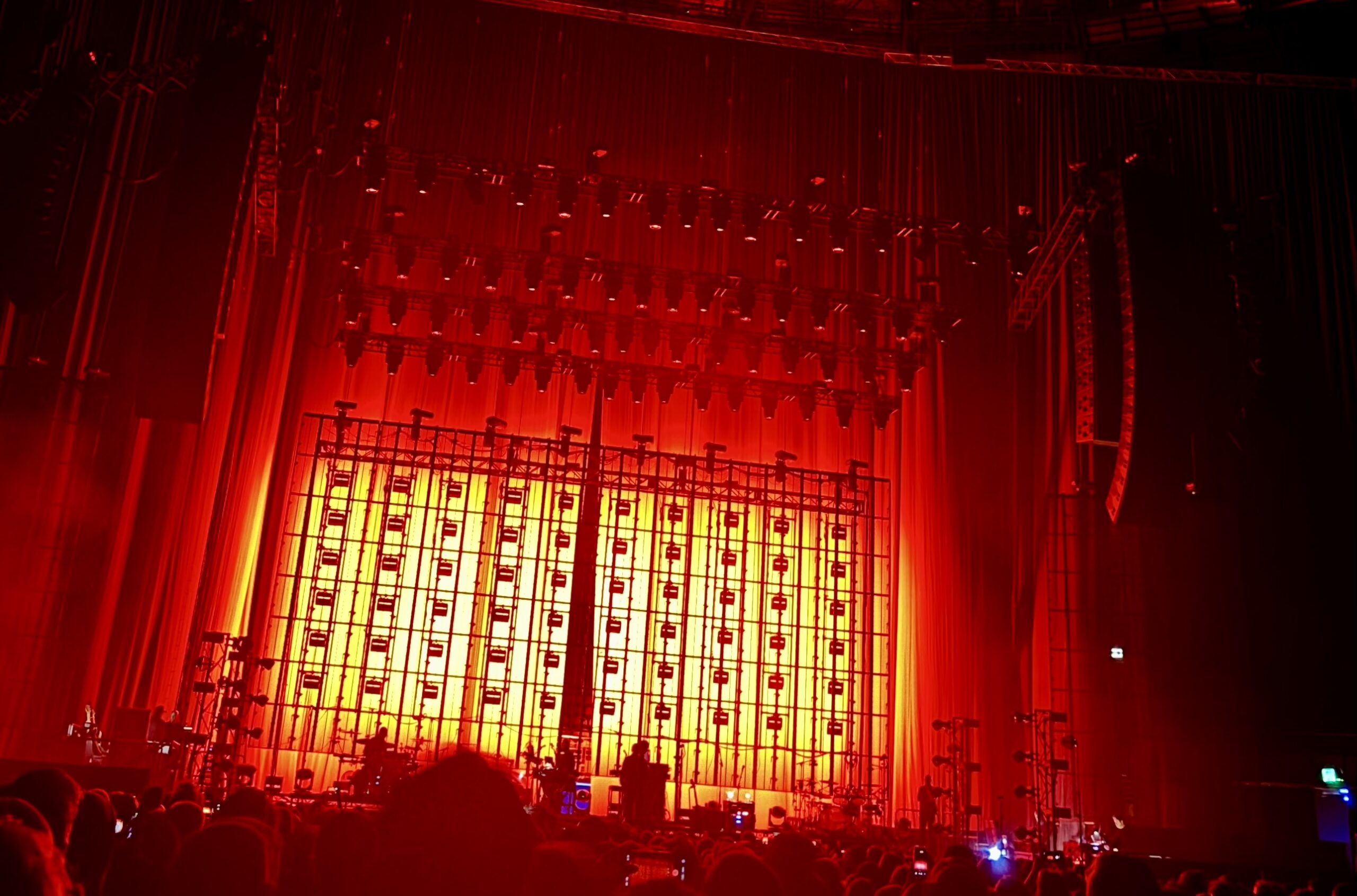
The live show was enormous. Songs accumulated weight until they felt almost architectural beneath Curtis’ towering visual work. That matters on an individual, physical level because the political force of the show doesn’t exist separately from the pleasure of hearing Massive Attack play. The sound and information work on you at the same time until the distinction between the cerebral and visceral becomes too difficult to maintain.
My doubt was instead about whether the show itself could survive the journey.
Part of what had made that night in Saint-Cloud feel so massive was its context, and I wondered what would happen when that same work travelled more than 16,000 kilometres away from the histories and institutions that seemed to give so much of Adams’ extensive video archive its weight. Perhaps it was the more open state of my mind in a foreign place, but I struggled to imagine how Australia would receive such a bold performance.
What I hadn’t properly considered was that the work didn’t have to remain the same.

The genius of the show is not that it draws neat conclusions from this chaos, but that it forces audiences to confront the connections within it.
– Clare Neal
Adam is a natural collaborator for Massive Attack because, in many ways, they operate according to the same creative logic: sampling.
Massive Attack have built a musical language around taking existing sounds and placing them somewhere unconventional. Similarly, Adam chops together snippets of recorded history. News broadcasts, social media dribble, political speeches, advertisements, surveillance footage, statistics and forgotten television segments are cut from their original contexts and rearranged until relationships emerge between things that might otherwise appear entirely unrelated.
It’s a masterclass in lateral thinking. An interdimensional, meaningful, often metaphorical connecting of dots.
When Massive Attack arrived in Australia, they brought with them new material local audiences are familiar with. Australian politicians appeared across Adams’ screens. Australian public figures, headlines and moments from our political history and cultural zeitgeist were folded into the same relentless stream as international wars, propaganda, surveillance, capitalism and technological power. Familiar names and faces were stripped of the context in which Australians usually encounter them and repositioned within a much larger story about how power operates.
The Wiggles reunion tour sold out faster than who? Delta Goodrem’s voice used to calm down what? Pauline Hanson did what? Guy Sebastian at which Bunnings sausage sizzle? Global military spend in 2025 was how much?
There was a disturbing familiarity in watching information behave this way. Politics, advertising, entertainment, war and the completely banal already occupy the same visual plane in our everyday lives. Catastrophe exists one swipe away from celebrity brainrot. A political crisis can be followed by an advertisement or meme.
By removing the option to scroll away, Adam illustrates that information is not the same thing as meaning. A dataset isn’t an explanation. Someone determines its parameters and which relationships are significant enough to display. No matter how factual the information may be, the surrounding architecture will always have power to skew and obfuscate. What makes an archive or a sample so different? In a country where citizens are worried about a global panopticon entering their local grocery monopoly, and where enormous pro-Palestine demonstrations have filled city streets, the ever-expanding systems Massive Attack and Adam are interrogating hardly feel distant. Surveillance, war, psy-ops, propaganda and the structures that determine whose stories are seen, heard or believed are already playing out around us. The genius of the show is not that it draws neat conclusions from this chaos, but that it forces audiences to confront the connections within it.
The Australian easter eggs extended into the music direction itself. Perhaps a little known fact to some Massive Attack fans, the song ‘In My Mind,’ sampled throughout the performance and a well known track in Adam’s cult documentary series Shifty, was originally written in 2012 by Australian house producers Ivan Gough, music duo Feenixpawl, featuring the vocals of English-born Australian musician Georgi Kay. The inclusion of local artists and references posed a meaningful intervention that Australia wasn’t simply playing host to Massive Attack and Adam Curtis’s work.
Instead, we have become source material.
Standing there, two years after declaring that I couldn’t imagine this show happening on home soil, I realised that my original thought was more interesting than whether I’d been right or wrong. Why would I ever wonder if a show like this could happen here? Perhaps my reaction in Saint-Cloud said more about my own perception of Australia’s global significance than it did about the show.
Australia has an antipodean-complex about its own relevance in the wider world. We’re deeply integrated into the global political, economic and cultural systems while maintaining an almost stubborn tendency to imagine ourselves at their geographical edge. History is always happening somewhere else. Artists become important when they succeed elsewhere. Despite our extensive, rich cultural history, international recognition remains one of the ways we reassure ourselves that we matter.
Massive Attack and Adam Curtis’ Australian shows dismantled that distance by implicating Australians in a broader narrative of universal complacency. Local politicians walk the same halls of power. Aussie media and history is filed into the same global archive. Home grown music entered the same sonic collage.
No matter their location, Massive Attack don’t ask audiences to observe their argument. Instead, they make them a part of the evidence.