For this special edition, the following questions are answered by Katrina Cashman, NAS Gallery Manager and Senior Curator, whose reflections on Margaret Olley’s life, artistic practice and legacy draw on years of research and personal encounters. Cashman also curated the exhibition Margaret Olley: Australian Intimiste in consultation with author and curator Christine France OAM, exploring Olley’s oeuvre through the lens of place and relationships.
As a young art student, Katrina Cashman was familiar with Margaret Olley’s art practice, though she did not meet her in person until 2002, when she was curating an exhibition and researching Controversy and Acclaim, a publication on the history of the Mosman Art Prize. Margaret Olley was the inaugural winner of the prize in 1947, and Cashman was keen to understand how winning the prize had influenced her career.
What Cashman remembers most from those early meetings was Olley’s generosity with her time and the genuine pleasure she took in being in her home. The pair shared several warm and convivial conversations. In the years that followed, Cashman met Olley on several more occasions and continued to follow her artistic practice closely.
Cashman remains inspired not only by the beauty and scale of Olley’s prodigious body of work, but also by her remarkable artistic tenacity. Olley’s determination to create, and the constant flow of her creative spirit, seemed as essential to her as breathing.
1. What inspired the creation of Margaret Olley: Australian Intimiste, and what story were you hoping to tell through this exhibition?
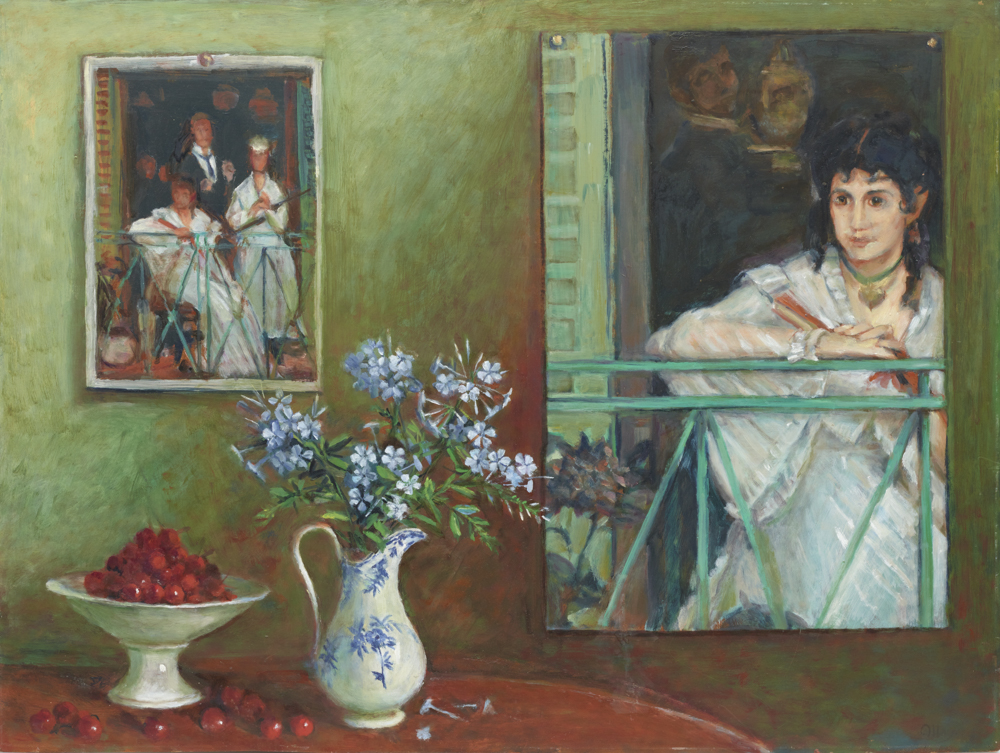
The exhibition was inspired by the primary focus of Maragret Olley’s life and career, her interior and still life painting. The exhibition is a positional study on Margaret Olley’s contribution as one of Australia’s chief proponents of the intimiste tradition. Her magnificent interiors and still-life works are meditations on presence, memory and the enduring power of the everyday, while her enduring commitment to the interior realm asserts the artistic significance of private space. The exhibition highlights Margaret Olley’s connection and sensitivity to her surroundings, and the refuge her various studios provided her throughout her life. Spanning six decades, the exhibition brings together over sixty of Olley’s works that trace the places that most inspired her— including early landscape works, her own homes (and those of friends) that she frequently moved and lived between, including her celebrated Duxford Street studio in Paddington. We decided to ground the exhibition in the National Art School, where Margaret Olley’s formative years as a student took place, where she learned essential technical skills and started her career and became part of a much wider arts network.
2. Looking back across Margaret’s career, what do you think she was always working towards? Was there an idea, feeling or pursuit that remained constant throughout her practice?
I think there was an accumulation, a constant pursuit of beauty, comingled with her continual drive to create. She was a huge collector and amassed a dazzling array of treasures in her homes which feature as subjects in her various works. She would often work on several paintings at any one time, she would move between rooms in her home painting at different times of day. Each space provided countless opportunities to make a new composition. While she achieved success from a very young age and was able to maintain this through her lifetime, and became widely admired, ultimately she painted and created for herself.
3. What themes, ideas or subjects remained constant throughout Margaret Olley’s practice, and why do you think they continued to resonate with her?
The focus on interiors and still life continued to resonate with Olley throughout her practice over her life time in her constant pursuit of beauty. She was most comfortable painting in her own homes and those homes of close friends. These home studios provided a form of sanctuary, a refuge in a sense. She was relaxed when surrounded by beauty of her own collections and things she cherished. While she had a charismatic personality and was often described as bold and forthright in company, she also preferred the quiet and solace of the studio where her imagination could flow and memory would also take part in her creations.
4. What was Margaret’s creative process like? Was she someone who carefully refined her work through many iterations, or did she trust her instincts from the beginning?
I think she largely worked instinctively but also worked concurrently on several paintings at once. She would work on a painting and then leave it for a while, allowing time to think and analyse the works, then edit, in an iterative process, when needed. The time and distance between working on artworks gave her space for ideas to germinate.
5. What sources of inspiration consistently shaped Margaret Olley’s work, and how do you see those influences reflected in her paintings?
The profound sense of interiority that characterises Olley’s domestic paintings functions as a form of self-portraiture, is also equally evident in her formal self-portraits. Her likeness, often glimpsed in mirrors, is enveloped by the curios and objets d’art that filled her homes. These objects bear witness to her avid collecting, serving as material evidence of a lifelong search for beauty. The sense of introspection within all of Olley’s works and especially within the self-portraits is visceral. She often referred to her art practice as a form of ‘voyaging within myself’.
6. What challenges or turning points do you think had the greatest impact on Margaret’s artistic practice, and how are they reflected in her work?
When William Dobell’s painting of her portrait won the 1948 Archibald Prize, there was a huge media uproar and a huge amount of unwelcome media focus on Olley’s personal appearance. This was really distressing for such a young, shy person and I think in many aspects had the effect of turning her inwards, to eventually find solace in her developing sense of self, and sense of interiority.
7. Would you describe Margaret’s practice as being driven more by intuition or discipline, or a balance of both? What makes you say that?
Her practice was driven by an insatiable need to create, she was also grounded in excellent technical training that she received in the rigorous curriculum at the East Sydney Technical College. This underpinned all her work and taught her incredible discipline, which was then balanced later with her artistic intuition.
8. How would you describe Margaret’s approach to making art? Were there any routines, habits or ways of working that became central to her practice?
She usually preferred to work on boards that had been primed with wash of a matt ochre background, then marked in her initial sketch drawings with white chalk/pastel. This was overpainted with acrylic and finally the image was painted in oils. These processes suited her and as mentioned before she liked to have several images on the go at any one time.
9. Having spent so much time immersed in Margaret Olley’s work while curating this exhibition, what has surprised or stayed with you the most?
The energy and verve of her later works which became quite expressive is a wonderful thing to experience. Age did not weary her, rather it spurred her on, and that she took on the challenge of creating scaled major works later in life.
10. If someone could only spend a few minutes with the exhibition, is there one artwork or moment you hope they don’t miss, why?
The seminal image Self portrait in the Mirror, 1948 is a wonderful portrait which is a tour de force, such a strong depiction of self, created when Olley was emerging as an artist of note. She was very young, and establishing her artistic voice and visual vocabulary, this distinctive image created the mood and sign of what was to come in her outstanding career.